3D Printing Nylon - From Knowledge to Production Guide
Nylon (PA) is a top-tier engineering material for functional 3D printing, particularly via SLS and MJF processes, valued for its exceptional toughness, wear resistance, and chemical resistance. While challenging for FDM due to warping and moisture sensitivity, it enables strong end-use parts when printed correctly. Its hygroscopic nature demands rigorous drying and post-processing management. Nylon excels in demanding applications across automotive, aerospace, and industrial sectors where durability under mechanical stress or chemical exposure is paramount, offering a balance of properties unmatched by most other common 3D printing polymers.
Nylon
Basic Characteristics & Composition
- Material Type: Semi-crystalline engineering thermoplastic (Primarily PA 12, PA 11, PA 6, Nylon 6/66, plus glass/carbon/mineral-filled composites).
- Key Traits: High strength-to-weight ratio, excellent toughness/impact resistance, good chemical resistance (oils, fuels, solvents), inherent lubricity/low friction, good fatigue resistance, flexible (unfilled).
- Critical Note: Hygroscopic - readily absorbs moisture, degrading printability and affecting final part properties. Requires strict drying before printing.
Color
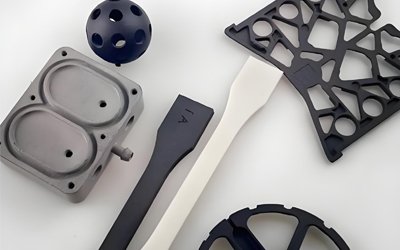
- Natural Unfilled: Typically off-white to light beige/tan (PA12 SLS), natural white/translucent (filaments).
- Dyed/Pigmented: Wide range available (black, white, gray, blue, red, etc.) for filaments and some SLS powders.
- Reinforced Composites: Glass-filled (off-white/beige), Carbon-filled (black), Mineral-filled (gray/white).
Material Performance (Typical Unfilled PA12)
Mechanical:
Friction/Wear: Low coefficient of friction, excellent abrasion resistance (ideal for moving parts).
Moisture Absorption: High (PA12: ~2-3% saturation in air; PA6: ~6-9%). Significantly reduces strength/stiffness but increases toughness/impact resistance. Requires sealing for dimensional stability.
UV Resistance: Moderate to poor; degrades/yellows over time without stabilizers or coatings.
- Tensile Strength: 40-50 MPa (SLS), 50-60 MPa (MJF), ~45-55 MPa (FDM).
- Flexural Strength: 45-60 MPa.
- Impact Strength (Notched Izod): 40-60 J/m (Excellent toughness).
- Elongation at Break: 15-30% (High ductility).
- Hardness: Shore D ~70-75.
- Melting Point: ~176-185°C (PA12), ~220°C (PA6).
- HDT @ 0.45 MPa: ~55-65°C (unfilled), >150°C (glass/carbon-filled).
Friction/Wear: Low coefficient of friction, excellent abrasion resistance (ideal for moving parts).
Moisture Absorption: High (PA12: ~2-3% saturation in air; PA6: ~6-9%). Significantly reduces strength/stiffness but increases toughness/impact resistance. Requires sealing for dimensional stability.
UV Resistance: Moderate to poor; degrades/yellows over time without stabilizers or coatings.
Application Scenarios & Fields
- Functional Prototypes: Housings, gears, brackets, snap-fits, mechanisms requiring toughness.
- End-Use Parts: Low-volume production components (especially SLS/MJF).
- Wear Components: Bearings, bushings, rollers, guides, conveyor parts, seals/gaskets (flexible grades).
- Fluid Handling: Fuel line components, pneumatic fittings, valve bodies, pump impellers (chemical resistant grades).
- Automotive: Under-hood brackets, fluid reservoirs, cable management, custom clips.
- Aerospace: Ducting, interior panels, drone components, lightweight housings.
- Industrial: Jigs, fixtures, tooling grips, robotic end-effectors, custom machinery parts.
- Consumer Goods: Sporting goods, wearable device straps, ergonomic handles, eyewear frames (PA11/12 biocompatible grades).
- Medical (Certified Grades): Surgical guides, prosthetics/orthotics, non-implantable devices.
3D Printing Process Adaptability
Primary Processes:
- Selective Laser Sintering (SLS): Most Common & Suitable. Powder bed process ideal for complex geometries, no supports needed, excellent mechanical isotropy, high detail. PA12 is the dominant material. Requires controlled environment.
- Multi Jet Fusion (MJF): Similar to SLS (uses powder bed, fuses with ink/IR). Faster than SLS, slightly better surface finish, excellent mechanical properties, consistent part quality. Primarily uses PA12/PA11.
- Fused Deposition Modeling (FDM/FFF): Uses filament. Challenging due to warping, moisture sensitivity, and adhesion issues. Requires heated chamber (>45°C), heated bed (70-100°C), enclosure, dry filament, and often adhesive. Mostly PA6, PA6/66, PA12 blends. Bridging and overhangs can be difficult.
- Material Extrusion (Pellets - Large Format): For very large parts using pellet-fed systems. Less common.
- Drying: MANDATORY. Filaments/powder must be thoroughly dried immediately before printing (e.g., 70-80°C for 4-8+ hours for filament, per powder manufacturer specs).
- Warping (FDM): High risk due to crystallinity and shrinkage. Heated chamber/enclosure, bed adhesion solutions (PVA glue, specialized build plates), slow cooling, and optimal orientation are critical.
- Moisture During Printing (FDM): Wet filament causes bubbling, poor layer adhesion, and weak parts. Use dry boxes or direct feed systems.
- Layer Adhesion: Generally good in SLS/MJF. Critical in FDM - requires optimal nozzle temp and sufficient extrusion.
- Powder Handling (SLS/MJF): Requires post-processing (cooling, depowdering, bead blasting) and powder management/recycling.
Advantages in 3D Printing
- Excellent Mechanical Properties: Best-in-class toughness and impact resistance among common 3D printing polymers.
- High Durability & Wear Resistance: Ideal for functional, moving parts under load.
- Chemical Resistance: Suitable for demanding environments (oils, fuels).
- Design Freedom (SLS/MJF): Complex geometries, internal channels, living hinges, snap-fits possible without supports.
- Good Surface Finish (SLS/MJF): Relatively smooth, sandable, paintable.
- Biocompatible Options (PA11/PA12): Available for medical applications.
- Material Versatility: Wide range of unfilled, filled (glass, carbon), and flexible blends.
Limitations in 3D Printing
- Hygroscopicity: Major challenge – requires extensive drying, careful storage, and often post-print sealing (epoxy, paint) for critical applications.
- Warping & Shrinkage (FDM): High difficulty level for FDM printing; limits large/flat parts.
- UV Degradation: Unsuitable for long-term outdoor use without stabilizers/coatings.
- Surface Finish (FDM): Often rougher than SLS/MJF; prone to stringing/oozing.
- Cost: Higher material cost than PLA, ABS, PETG. SLS/MJF printing services can be expensive.
- Anisotropy (FDM): Strength is lower perpendicular to layers.
- Limited High-Temp Performance (Unfilled): HDT lower than materials like PEEK or PEI.
- Post-Processing: SLS/MJF requires significant powder removal. FDM parts often need support removal and smoothing.
Major Manufacturers & Material Brands
- SLS/MJF Powders: BASF (Ultrasint® PA6, PA11, PA12, FR), EOS (PA 2200/PA12, PA 1101/PA11, PA 3200 GF/Glass-filled, PrimePart series), HP (PA 11, PA 12, PA 12 Glass Beads), 3D Systems (DuraForm® PA, EX-FL AM), Stratasys (Fuse Series PA12), Evonik (VESTOSINT® PA12), Arkema (Rilsan® PA11 powders).
- FDM Filaments: BASF Ultramid® (PA6, PA66), DuPont Zytel® 3D (PA, PA+Mineral), Evonik (VESTAMID® NRG PA12), Kimya (PA6, PA12, Carbon-PA), Taulman Alloys (nylon blends), Polymaker (PolyMide™ PA6, PA6-GF), MatterHackers NylonX (Carbon-filled), eSUN ePA-CF.
Common Alternatives for 3D Printing
- For Higher Temp/Strength: PEKK, PEEK (Significantly higher temp, strength, cost; harder to print).
- For Easier Printing & Stability: PETG (Good toughness, easier FDM, moisture resistant, lower temp), ASA (UV stable, easier FDM than ABS, good outdoor use).
- For Flexibility: TPU/TPE (Elastomeric, high flexibility and impact absorption).
- For Stiffness & Precision: ABS (Good strength/stiffness, easier FDM than nylon but lower impact/temp), Polycarbonate (PC) (Higher strength/stiffness/HDT than nylon, tough, prone to warping).
- For Cost-Effective Prototyping: PLA (Easy to print, rigid, brittle, low temp), ABS.
- For SLS Durability: TPU (Powder) For flexible parts.
Other services materials options

Request Your DFM & Quote – Upload Your Drawings
ㆍFill in your requirements and upload your 2D&3D file, we will feedback your project quotation and DFM within 24 hours.ㆍFile types: STEP, STP, IGES, IGS, SLDPRT, 3DM, SAT or X_T files File size: < 128 MB Part size: < 1500*1500*1500 mm
ㆍPrivacy: We respect your privacy. Here you can find an example of a non-disclosure agreement. By submitting this form, you agree to our terms & conditions and privacy policy.
ㆍPrivacy: We respect your privacy. Here you can find an example of a non-disclosure agreement. By submitting this form, you agree to our terms & conditions and privacy policy.