
3D Printed vs Machined Plastic: Mastering High-Pressure Seals
Views: 2 Author: Allen Xiao Publish Time: 2026-02-07 Origin: Site


Watching a critical suspension bracket violently snap in half during a routine drop test instantly exposes the harsh reality of molecular physics. Engineering load-bearing mechanisms forces procurement managers to look far beyond the basic geometric shape on their computer screen. Choosing the incorrect manufacturing process guarantees your expensive prototype will physically disintegrate the moment it faces real-world kinetic stress.
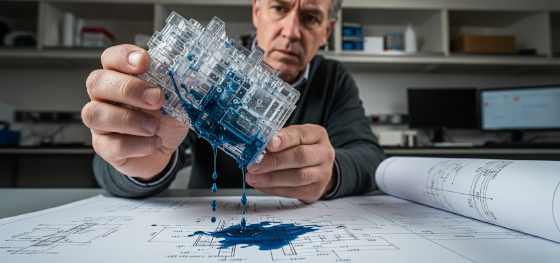
Settling the brutal debate between 3d printed vs machined plastic demands a ruthless audit of how raw materials physically bond together. Extruding melted filament naturally builds geometries by stacking weak horizontal layers on top of each other. Subtractive milling entirely bypasses this thermal weakness by violently carving flawless geometry directly out of heavily compressed, highly dense commercial billets.
Executing flawless functional assemblies requires understanding how these internal molecular structures react to sheer torque. Fastening heavy components together with stainless steel bolts routinely destroys layered geometries that lack true isotropic tensile strength. Aviation and medical hardware engineers cannot gamble human safety on microscopic thermal bonds that shatter under aggressive harmonic vibration.
Operating out of the aggressive Shenzhen precision manufacturing hub equips our veteran engineers with an unbiased perspective. We aggressively deploy both advanced additive systems and heavy 5-axis milling centers on the exact same factory floor. This hybrid capability forces us to honestly evaluate where layered geometries succeed and where solid subtractive blocks become absolutely mandatory for survival.
content:
Defeating Anisotropic Layer Delamination
Achieving High-Pressure Fluid Manifold Sealing
Mastering Threaded Fastener Integration
JUCHENG Hub: Unbiased Manufacturing Selection
Frequently Asked Questions: Polymer Physics
Defeating Anisotropic Layer Delamination
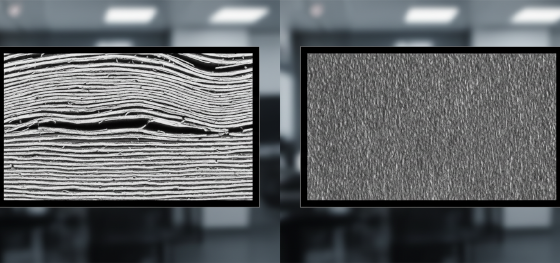
Do printed nylons possess the exact same mechanical sheer strength as a solid machined nylon block?
Absolutely not. Layer-based extrusion naturally suffers from anisotropic weakness, meaning the part will split cleanly along the Z-axis bonds, whereas a solid machined billet handles impact stress identically from every possible direction.
Relying on standard desktop extrusion technologies for heavy mechanical linkages is engineering suicide. The thermal fusion between layer fifty and layer fifty-one mathematically remains significantly weaker than the continuous filament strand itself. Applying aggressive lateral torque against these microscopic seams physically peels the component apart like a deck of cards.
Subtractive milling violently removes material from heavily compressed, stress-relieved plastic rods. If you mill a heavy-duty robotic transmission mount from solid Delrin or PEEK, the raw crystalline structure remains entirely undisturbed. This monolithic density safely absorbs massive kinetic shock loads regardless of which geometric angle the violent impact comes from.
Upgrading to advanced Selective Laser Sintering (SLS) offers a robust middle ground for complex geometries. High-power lasers melt nylon powder beds so intensely that the resulting part achieves nearly perfect isotropic tensile strength without requiring expensive CNC setups. However, the surface finish remains slightly porous and powdery compared to the mirror-like smoothness of a freshly milled surface.
Achieving High-Pressure Fluid Manifold Sealing

Can complex additive enclosures safely hold pressurized pneumatic air or hydraulic fluids without leaking?
Rarely. Microscopic voids trapped between the melted filament layers act as tiny escape tunnels, causing the component to sweat and slowly bleed pressurized fluids straight through the solid-looking walls.
Designing complex internal cooling channels forces engineers to evaluate critical fluid manifold sealing capabilities. Fused Deposition Modeling inherently lacks absolute molecular density, trapping thousands of tiny air pockets during the rapid cooling phase. Subjecting these brittle walls to fifty PSI of hydraulic pressure violently forces the liquid out through the microscopic layer seams.
Medical device manufacturers routinely rely on stereolithography (SLA) resin processes for fluidic prototypes because the liquid resin cures into a watertight, solid block. However, SLA resins remain notoriously brittle and highly sensitive to chemical degradation over time. Subjecting these clear manifolds to harsh hospital cleaning solvents often causes them to craze, crack, and shatter catastrophically.
Milling pneumatic manifolds out of solid extruded acrylic or polycarbonate billets completely eradicates leakage risks. The CNC spindle carves the internal channels out of a mathematically flawless, non-porous block. Utilizing specialized vapor polishing techniques restores the internal channels to absolute optical clarity, allowing engineers to visually track fluid dynamics without fearing sudden pressure blowouts.
| Performance Metric | Industrial 3D Printing (FDM/SLS) | CNC Machining (Subtractive) | Engineering Impact on Design |
|---|---|---|---|
| Material Density | Porous (Micro-voids present) | 100% Solid Monolithic | Milling dominates high-pressure fluid tasks |
| Geometric Complexity | Infinite (Internal voids free) | Limited by line-of-sight tools | Printing allows impossible conformal cooling |
| Surface Finish Accuracy | Noticeable layer lines remain | Flawless micron-level smoothness | CNC required for tight bearing press-fits |
| Direct Thread Tapping | Fails instantly (Requires brass inserts) | Excellent holding power | Machining drastically speeds up final assembly |
Mastering Threaded Fastener Integration
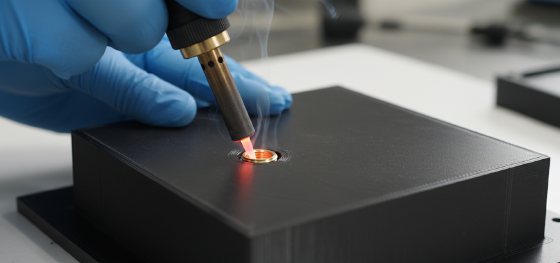
Can a technician safely cut mechanical threads directly into a printed plastic hole?
It is incredibly dangerous. Cutting sharp threads severs the internal filament layers, creating massive stress concentrators that strip out instantly the moment you tighten the bolt.
Securing heavy electronics enclosures forces engineers to design robust fastening strategies. Relying on ultrasonic heat-set inserts remains the absolute gold standard for layered plastics. Technicians physically melt custom brass anchors directly into the printed walls, allowing the molten polymer to flow around the knurled metal, locking the indestructible machine threads permanently into place.
Subtractive milling entirely eliminates this tedious secondary assembly step. Because extruded plastic billets possess massive monolithic density, CNC spindles can rigidly tap incredibly fine threads directly into the raw material. Threading solid Delrin or Nylon provides immense torque resistance, allowing technicians to assemble and disassemble the prototype thousands of times without stripping the hole.
JUCHENG Hub: Unbiased Manufacturing Selection
Why do some hardware brokers aggressively push printing even when milling is mechanically superior?
Because running a basic plastic printer requires zero CAM programming expertise and no costly setup time. They protect their own profit margins by delivering sub-par mechanical strength to your engineering team.
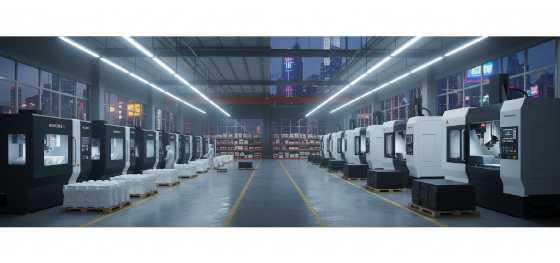
Partnering with Jucheng Precision entirely removes this toxic bias from your supply chain. Owning a massive fleet of industrial additive systems directly alongside heavy 5-axis milling centers allows our engineers to evaluate your digital CAD file objectively. We dictate the manufacturing process based strictly on your required mechanical tolerances, not our operational convenience.
Executing complex hybrid projects separates our facility from amateur print farms. If an aerospace client needs an impossibly lightweight drone chassis featuring perfectly smooth, watertight bearing housings, we print the complex organic geometry first. We then seamlessly mount the printed part onto a heavy CNC mill to subtractively finish the critical mating surfaces with absolute perfection.
Frequently Asked Questions: Polymer Physics

Does CNC machining soft plastics cause severe dimensional warping?
Yes. Heavily extruded plastics trap massive internal manufacturing stresses. Violently milling away the outer skin releases this stress rapidly, causing the part to twist. Machinists must utilize stress-relieved plastic grades and take multiple balanced cuts across both sides to survive this warpage.
Can a spinning endmill create a perfectly sharp internal square corner inside a plastic pocket?
It is physically impossible. Round cutting tools mathematically leave an internal radius matching their own diameter. Hardware engineers must intelligently design dog-bone reliefs into the CAD file to allow square mating components to fit properly without colliding with the rounded corners.
Are additive plastics inherently weaker against harsh industrial chemicals than machined plastics?
Not necessarily due to the chemistry, but the physical porosity ruins the part. Harsh chemicals and solvents aggressively seep into the microscopic layer lines and voids of a printed part, drastically increasing the exposed surface area and accelerating the chemical degradation process significantly.



ㆍPrivacy: We respect your privacy. Here you can find an example of a non-disclosure agreement. By submitting this form, you agree to our terms & conditions and privacy policy.