
Aluminum Alloy 7075-T6 CNC Machining Material
When a project demands the lightness of aluminum but the strength of steel, Aluminum Alloy 7075-T6 is the undisputed answer. As the primary zinc-bearing alloy, 7075 offers one of the highest strength-to-weight ratios of any machinable metal. It is the backbone of the aerospace industry and high-performance engineering. At JUCHENG, we treat 7075-T6 with the precision it deserves. From machining complex aircraft frames to producing durable prototype injection molds, our facility is equipped to handle this hard, high-stress material, delivering components that perform reliably under extreme mechanical loads.
Aluminum Alloy 7075-T6 Material
JUCHENG's 7075-T6 Machining Capabilities
Processing ultra-high-strength aluminum requires rigid machinery and smart strategies. We offer:
- Hard Metal Machining: Although it is aluminum, 7075 cuts more like steel. We utilize high-torque spindles and specialized carbide end mills to achieve rapid material removal without tool chatter.
- Stress Management: 7075 can have high internal stresses. We recommend and stock T651 (stress-relieved) plates for parts requiring tight flatness tolerances to prevent warping during machining.
- Mold Making: We utilize 7075-T6 to manufacture high-quality prototype injection molds. Its hardness allows it to withstand injection pressures for thousands of cycles, offering a faster and cheaper alternative to tool steel.
- Hard Anodizing: To further enhance its wear resistance, we provide Type III Hard Anodizing, creating a surface almost as hard as diamond.
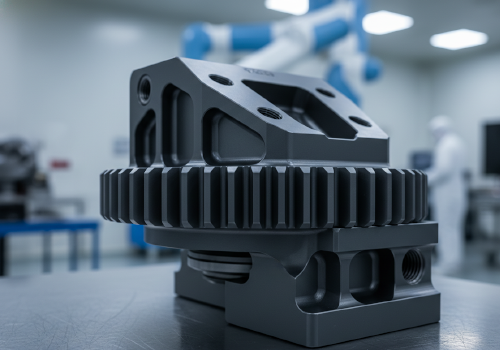
Advantages of CNC Machining 7075-T6
| Advantage | Detailed Description | Key Benefit |
| Extreme Strength | Yield strength (~503 MPa) is nearly double that of 6061-T6. Comparable to some stainless steels. | Essential for parts under high tensile stress, such as gears and aircraft wing structures. |
| High Fatigue Strength | Excellent resistance to micro-cracking under cyclic loading. | Critical for rotating machinery, shafts, and suspension components. |
| Superior Machinability | It is harder/brittler than 6061, allowing chips to break easily. | Produces an exceptionally fine surface finish with minimal burrs. |
| Wear Resistance | Its natural hardness resists abrasion better than softer alloys. | Suitable for bearing surfaces, sliding mechanisms, and tool bodies. |
| Polishing Potential | Due to its hardness, it can be polished to a very high, defect-free luster. | Ideal for cosmetic parts that also require structural integrity. |
Technical Parameters & Material Standards
We process 7075 in its most critical tempers:
| Grade Category | Specification | Characteristics & Ideal Uses |
| Aluminum 7075-T6 | ASTM B209 | Solution heat-treated and artificially aged. Maximum mechanical strength. Standard for rods and smaller blocks. Uses: High-performance gears, shafts, aircraft fittings, missile parts. |
| Aluminum 7075-T651 | Stress Relieved | Stretched after heat treatment to relieve internal stress. Essential for machining large plates or parts with heavy material removal to maintain flatness. Uses: Aerospace bulkheads, mold bases, precision fixtures, robotic arms. |
CNC Machining Guidelines for 7075
- Corrosion Protection: 7075 has average corrosion resistance (lower than 6061 due to copper/zinc content). It should be anodized or coated (Alodine) for outdoor use.
- Welding: Do Not Weld. 7075 is generally considered unweldable by standard methods (causes cracking and strength loss). Assemblies should be bolted or bonded.
- Cost: It is significantly more expensive than 6061. We advise using it only when the mechanical properties are strictly necessary.
- Drilling: Requires robust setups. Peck drilling is essential to clear the hard chips and prevent heat buildup which can affect the temper.
Application Scenarios
- Aerospace: Wing spars, fuselage frames, helicopter rotor components.
- Mold Making: Blow molds, prototype injection molds, foam molds.
- Sports Equipment: Rock climbing carabiners, bicycle frames, lacrosse stick shafts.
- Defense: Rifle receivers, precision optics housings, ordnance components.
- Robotics: High-speed robot arms where low inertia (lightweight) and high stiffness are required.
Physical Properties Table
The strength gap: 7075-T6 vs 6061-T6:
| Property | Aluminum 7075-T6 | Aluminum 6061-T6 | Unit |
| Density | 2.81 | 2.70 | g/cm³ |
| Tensile Strength | 572 | 310 | MPa |
| Yield Strength | 503 | 276 | MPa |
| Hardness (Brinell) | 150 | 95 | HB |
| Elongation | 11 | 12 | % |
| Corrosion Resistance | Average | Very Good | - |
| Weldability | Poor | Good | - |

Request Your DFM & Quote – Upload Your Drawings
ㆍFill in your requirements and upload your 2D&3D file, we will feedback your project quotation and DFM within 24 hours.ㆍFile types: STEP, STP, IGES, IGS, SLDPRT, 3DM, SAT or X_T files File size: < 128 MB Part size: < 1500*1500*1500 mm
ㆍPrivacy: We respect your privacy. Here you can find an example of a non-disclosure agreement. By submitting this form, you agree to our terms & conditions and privacy policy.
ㆍPrivacy: We respect your privacy. Here you can find an example of a non-disclosure agreement. By submitting this form, you agree to our terms & conditions and privacy policy.