
PA+GF30 (Glass Filled Nylon) CNC Machining Material
PA+GF30 refers to Polyamide (Nylon) reinforced with 30% glass fibers. This composite material significantly upgrades the properties of standard nylon, offering vastly superior stiffness, tensile strength, and heat resistance. It is often used as a direct replacement for metal die-cast parts in weight-sensitive applications.
PA+GF30 CNC Machining
JUCHENG's PA+GF30 Machining Capabilities
At JUCHENG, we have specialized expertise in CNC machining Glass-Filled Nylon. Processing this abrasive material requires hardened tooling and optimized cutting strategies to maintain tolerances and surface quality. We stock and machine both PA6-GF30 and PA66-GF30 grades, delivering robust structural components for the automotive, power tool, and industrial machinery sectors.
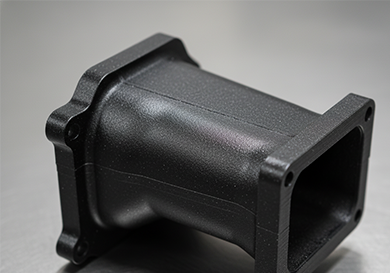
Advantages of CNC Machining PA+GF30
| Advantage | Detailed Description | Key Benefit |
| High Stiffness & Strength | Glass fibers act as reinforcement, doubling or tripling the tensile strength and stiffness compared to unfilled nylon. | Ideal for structural parts that must bear heavy static loads without bending or deforming. |
| Superior Heat Resistance | Significantly increases the Heat Deflection Temperature (HDT), allowing parts to perform near engine blocks or heat sources. | Essential for under-the-hood automotive parts and power tool housings. |
| Dimensional Stability | Glass fibers reduce the coefficient of thermal expansion and moisture absorption rate compared to standard nylon. | Parts hold their shape better in varying temperatures and humid environments. |
| Creep Resistance | Resists deformation under long-term stress or load much better than unfilled plastics. | Suitable for functional parts like snap-fits, housings, and fasteners under constant tension. |
| Metal Replacement | Offers strength comparable to some metals (like magnesium or aluminum alloys) but at a fraction of the weight. | Reduces overall system weight and production costs without sacrificing durability. |
Technical Parameters & Material Properties
We offer different reinforcement levels, with 30% being the industry standard:
| Grade Category | Composition | Detailed Characteristics | Ideal Applications |
| PA66 GF30 (Standard) | Nylon 66 + 30% Glass Fiber | The industry standard for high-performance engineering plastics. It offers the highest stiffness, mechanical strength, and heat resistance (HDT up to 250°C). It is harder and more rigid than PA6 GF30 but slightly more brittle. | Automotive intake manifolds, radiator end tanks, power tool casings, structural gears. |
| PP CopolymPA6 GF30er | Nylon 6 + 30% Glass Fiber | Offers improved toughness and better surface finish compared to PA66 GF30. It processes slightly easier and is often more cost-effective. Excellent for parts requiring both strength and impact resistance. | Consumer product housings, furniture components, industrial handles, engine covers. |
| PA66 GF15 / GF50 | 15% or 50% Glass Fiber | GF15: Lower glass content for a balance of toughness and stiffness.GF50: Extremely high stiffness for ultimate metal replacement, but very abrasive to tools and brittle. | GF15: Impact-prone housings.GF50: Heavy-duty structural brackets replacing aluminum. |
CNC Machining Guidelines for PA+GF30
Machining glass-filled nylon presents unique challenges due to the abrasive nature of glass fibers. JUCHENG uses the following protocols:
- Tooling Strategy: Glass fibers are extremely abrasive and will rapidly dull standard high-speed steel (HSS) tools. We use carbide or diamond-coated (DLC) tools to maintain sharp cutting edges and dimensional accuracy.
- Surface Finish: Machined glass-filled parts have a matte, slightly rough texture because the glass fibers are exposed at the surface. They do not polish to a high gloss like unfilled nylon.
- Warpage Control: Glass-filled materials are anisotropic (properties vary by direction). Machining can release internal stresses leading to warp. We use symmetrical material removal and annealing to keep parts flat.
- Heat Management: Although heat-resistant, the plastic matrix can still melt. We use aggressive cooling to prevent the plastic from smearing over the glass fibers.
Application Scenarios
PA+GF30 is the go-to material for demanding structural applications:
- Automotive: Air intake manifolds, engine covers, radiator tanks, oil pans, pedal assemblies.
- Power Tools: Drill housings, grinder bodies, internal gearboxes (high heat/vibration resistance).
- Industrial: Pump bodies, impellers, heavy-duty valve handles, conveyor system structural links.
- Consumer Goods: High-end office chair frames, durable sports equipment components.
- Aerospace: Structural brackets, cable clamps, interior mechanical assemblies.
Physical Properties Table
| Property | Unfilled PA66 | PA66 GF30 | Unit |
| Density | 1.15 | 1.35 - 1.40 | g/cm³ |
| Tensile Strength | 85 | 160 - 180 | MPa |
| Flexural Modulus | 2,900 | 9,000 - 10,000 | MPa |
| Elongation at Break | 60 | 3 - 5 | % |
| Heat Deflection Temp (1.8 MPa) | 70 - 85 | 250 | °C |
| Water Absorption (24h) | 1.2 | 0.9 | % |
| Hardness (Rockwell) | R120 | R121 / M100 | - |

Request Your DFM & Quote – Upload Your Drawings
ㆍFill in your requirements and upload your 2D&3D file, we will feedback your project quotation and DFM within 24 hours.ㆍFile types: STEP, STP, IGES, IGS, SLDPRT, 3DM, SAT or X_T files File size: < 128 MB Part size: < 1500*1500*1500 mm
ㆍPrivacy: We respect your privacy. Here you can find an example of a non-disclosure agreement. By submitting this form, you agree to our terms & conditions and privacy policy.
ㆍPrivacy: We respect your privacy. Here you can find an example of a non-disclosure agreement. By submitting this form, you agree to our terms & conditions and privacy policy.