
POM (Delrin/Acetal) CNC Machining Material
POM (Polyoxymethylene), commonly known as Acetal, Polyacetal, or by the premium trade name Delrin®, is a high-performance engineering thermoplastic. It is widely prized in the CNC industry for its high stiffness, low friction, and exceptional dimensional stability. At JUCHENG, POM is a staple material for our precision machining services. We utilize advanced 5-axis CNC milling and turning centers to produce complex POM parts that require tight tolerances and superior surface finishes. Our facility processes a wide range of Acetal grades—from standard Copolymer to high-strength Homopolymer—serving automotive, medical, and consumer electronics sectors under strict ISO 9001 and IATF 16949 quality standards.
POM CNC Machining
What is POM (Delrin/Acetal)?
POM is a semi-crystalline thermoplastic that bridges the gap between metals and ordinary plastics. Often referred to as "the metal of plastics," it offers high strength and rigidity while maintaining natural lubricity and resistance to moisture.
It is available in two primary chemical structures:
Acetal Copolymer (POM-C): The industry standard, offering better chemical resistance and thermal stability.
Acetal Homopolymer (POM-H / Delrin®): Offers slightly higher mechanical strength and stiffness but is more prone to centerline porosity.
It is available in two primary chemical structures:
Acetal Copolymer (POM-C): The industry standard, offering better chemical resistance and thermal stability.
Acetal Homopolymer (POM-H / Delrin®): Offers slightly higher mechanical strength and stiffness but is more prone to centerline porosity.
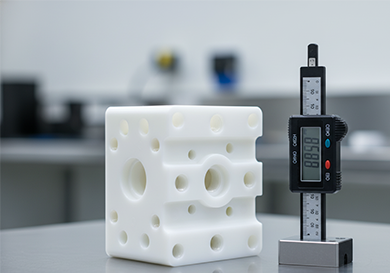
Advantages of CNC Machining POM (Delrin)
| Advantage | Detailed Description | Key Benefit |
| Superior Machinability | POM creates short, broken chips rather than long stringy ones. It is considered the most machinable plastic. | Allows for fast feed rates, extended tool life, and excellent "as-machined" surface finishes (Ra 0.8 - 1.6µm). |
| High Dimensional Stability | Exhibits very low moisture absorption (0.2%) compared to Nylon. | Parts retain tight tolerances (+/- 0.02mm) even in humid or wet environments. |
| Low Friction & Wear | Possesses natural lubricity and a low coefficient of friction against metals. | Ideal for sliding mechanisms, gears, and bearings without external lubrication. |
| High Stiffness & Strength | High flexural modulus and creep resistance. | Maintains structural integrity under continuous load, suitable for snap-fits and spring elements. |
| Chemical Resistance | Resistant to solvents, fuels, alcohols, and neutral chemicals (especially POM-C). | Perfect for automotive fuel system components and industrial solvent handling. |
Technical Parameters & Material Properties
We stock and machine a comprehensive range of POM grades to meet specific technical requirements:
| Grade Category | Common Brands / Specs | Detailed Characteristics | Ideal Applications |
| POM-C (Acetal Copolymer) | Ultraform®, Celcon®, Tecaform® | High resistance to hydrolysis (hot water up to 80°C) and strong alkalis. Free from "centerline porosity" issues common in homopolymers. More thermally stable during machining.Porosity: Porosity-free. | Food contact parts, plumbing components, chemical pump housings, bushings in wet environments. |
| POM-H (Acetal Homopolymer) | DuPont™ Delrin® 150, Delrin® 100 | Higher tensile strength, stiffness, and hardness than Copolymer. Better fatigue resistance. However, thick sections may contain centerline porosity (voids) due to the manufacturing process.Stiffness: ~15% stiffer than POM-C. | High-load precision gears, thin-walled parts, springs, snap-fit assemblies, zippers. |
| PTFE-Filled POM | Delrin® AF Blend | POM blended with PTFE (Teflon) fibers. Drastically reduces the coefficient of friction and eliminates "stick-slip" behavior. Slightly lower mechanical strength than unfilled POM.<br>Friction: Ultra-low. | High-speed sliding bearings, guide rails, linear motion components, valve seats. |
| Glass-Filled POM | POM-GF25 (25% Glass) | POM blended with PTFE (Teflon) fibers. Drastically reduces the coefficient of friction and eliminates "stick-slip" behavior. Slightly lower mechanical strength than unfilled POM.Friction: Ultra-low. | Structural components under high static load, dimensionally critical housings. |
| ESD / Static Dissipative POM | Semitron® ESD 225 | Reinforced with glass fibers for significantly enhanced stiffness, tensile strength, and creep resistance. Reduced thermal expansion.Machining: Abrasive to tools. | Electronic fixture nests, disk drive components, semiconductor handling parts. |
CNC Machining Guidelines for POM
JUCHENG utilizes optimized processes to ensure high-precision POM parts:
- Clamping & Fixturing: POM has a low friction coefficient and can be slippery. We use serrated jaws or vacuum fixtures to secure parts firmly without excessive force that could cause deformation.
- Heat Sensitivity: POM is heat-sensitive. Overheating during machining can cause the material to decompose and outgas formaldehyde. We use sharp tools and adequate coolant to keep temperatures low.
- Tolerance Control: Because POM is dimensionally stable, we can routinely hold tolerances of +/- 0.02mm or better. It is one of the best plastics for precision work.
- Post-Processing: POM machining leaves a smooth, opaque finish. It does not accept paint or glue well due to its chemical resistance. We typically offer "as-machined" or bead-blasted finishes.
Application Scenarios
POM is widely used for precision parts requiring stiffness, low friction, and dimensional stability:
- Automotive: Fuel system sender units, door lock actuators, window lift gears, control switches, fuel caps.
- Consumer Electronics: Mechanical components in printers, zippers, appliance gears, keyboard switch components.
- Medical: Insulin pens, inhalers, surgical instrument handles (Medical grade POM required).
- Industrial Machinery: Conveyor links, guide rollers, springs, bushings, and snap-fit assemblies.
- Fluid Handling: Valve bodies, pump impellers, showerheads, and garden hose nozzles.
Physical Properties Table
Comparison of Copolymer vs. Homopolymer vs. Glass-Filled:
(Note: The values above are typical property values for reference purposes only. Actual values may vary depending on the specific supplier and grade.)
| Property | POM-C (Copolymer) | POM-H (Delrin®) | POM + 25% GF | Unit |
| Density | 1.41 | 1.42 | 1.59 | g/cm³ |
| Tensile Strength | 60 - 70 | 70 - 80 | 110 - 120 | MPa |
| Flexural Modulus | 2,600 | 3,000 | 7,500 | MPa |
| Elongation at Break | 20-30 | 40 - 50 | 2 - 3 | % |
| Melting Point | 165 | 175 | 165 | °C |
| Water Absorption (24h) | 0.20 | 0.25 | 0.20 | % |
| Friction Coefficient (vs Steel) | 0.25 | 0.28 | 0.35 | Dynamic |
| Hardness (Rockwell) | M80 / R120 | M86 / R122 | M90 | - |

Request Your DFM & Quote – Upload Your Drawings
ㆍFill in your requirements and upload your 2D&3D file, we will feedback your project quotation and DFM within 24 hours.ㆍFile types: STEP, STP, IGES, IGS, SLDPRT, 3DM, SAT or X_T files File size: < 128 MB Part size: < 1500*1500*1500 mm
ㆍPrivacy: We respect your privacy. Here you can find an example of a non-disclosure agreement. By submitting this form, you agree to our terms & conditions and privacy policy.
ㆍPrivacy: We respect your privacy. Here you can find an example of a non-disclosure agreement. By submitting this form, you agree to our terms & conditions and privacy policy.