
Polypropylene (PP) CNC Machining Material
Polypropylene (PP) is a tough, rigid, and crystalline thermoplastic widely used for its exceptional chemical resistance and fatigue strength. It is distinct for being one of the lightest commercial plastics (it floats in water) and for its unique ability to function as a durable "living hinge." At JUCHENG, we have extensive experience in Polypropylene CNC machining. While PP can be challenging to machine due to its tendency to burr and melt, our specialized tooling and deburring protocols ensure precise, clean components. We machine both Homopolymer and Copolymer grades for automotive, chemical processing, and consumer product applications.
What is Polypropylene (PP)?
Polypropylene is a semi-crystalline thermoplastic from the polyolefin family. It is known for its incredible resistance to organic solvents, degreasing agents, and electrolytic attack. Unlike harder plastics like Acrylic or PC, PP has a softer, waxy feel and is extremely tough. It bridges the gap between polyethylene (PE) and engineering plastics, offering higher heat resistance than PE while maintaining excellent flexibility and impact strength.
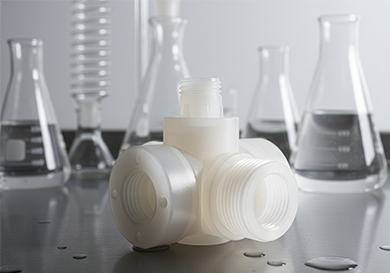
Advantages of CNC Machining Polypropylene (PP)
Ultimate Chemical ResistanceExcellent Electrical Properties
| Advantage | Detailed Description | Key Benefit |
| Excellent Electrical Properties | Resistant to diluted acids, concentrated acids, alcohols, bases, and mineral oils. | Ideal for chemical storage tanks, laboratory equipment, and acid-line fittings. |
| Fatigue Resistance | Retains shape and integrity even after thousands of bending cycles. | The primary material for Living Hinges (integrated flexible hinges) in prototypes. |
| Low Density (Lightweight) | Has the lowest density (approx. 0.90 g/cm³) of all commodity plastics. | Perfect for weight-sensitive automotive and aerospace applications (it floats in water). |
| Moisture Resistance | Water absorption is less than 0.01%. | Does not swell or degrade in wet or humid environments; excellent dielectric properties. |
| High Toughness | Excellent impact resistance, especially in copolymer grades. | Suitable for protective bumpers, durable containers, and structural parts. |
Technical Parameters & Material Properties
We stock and machine the primary variations of Polypropylene:
| Grade Category | Detailed Characteristics | Ideal Applications |
| PP Homopolymer | The standard general-purpose grade. Offers high strength-to-weight ratio and stiffness. Better heat resistance than copolymer but can be brittle at low temperatures. | Chemical tanks, pump housings, laboratory ware, rigid structural parts. |
| PP Copolymer | Polymerized with ethylene to improve impact strength and flexibility, especially at low temperatures. Slightly softer than homopolymer. | Automotive bumpers, battery cases, impact-prone industrial parts, cold-storage containers. |
| Glass-Filled PP | Reinforced with glass fibers (e.g., 30% GF). Significantly increases stiffness, tensile strength, and heat distortion temperature. | Automotive under-hood components, structural brackets, pump impellers. |
CNC Machining Guidelines for Polypropylene
Machining PP requires specific techniques to manage its low melting point and "gummy" nature. JUCHENG follows these guidelines:
- Heat Control: PP has a relatively low melting point (~160°C). We use sharp tools, high feed rates, and aggressive air/liquid cooling to prevent the material from melting and smearing on the cutter.
- Burr Control: PP is notorious for leaving persistent, stringy burrs. We employ rigorous manual deburring and cryogenic techniques to ensure clean edges on all machined parts.
- Clamping: Due to its waxy surface (low friction) and flexibility, PP can slip or deform. We use vacuum fixtures or large surface area clamping to secure parts without distortion.
- Surface Finish: Machined PP naturally has a matte, slightly textured finish. It is resistant to solvents, so it cannot be chemically polished; it is typically left "as-machined" or bead blasted.
Application Scenarios
- Chemical Industry: Acid tanks, valves, pipe fittings, fume hoods, plating barrels.
- Automotive: Bumpers, interior trims, battery housings, fluid reservoirs.
- Consumer Goods: Packaging prototypes, food containers (FDA grades), flip-top lids (Living Hinges).
- Medical: Orthotic devices, surgical trays (autoclavable), laboratory test tubes.
Physical Properties Table
| Property | PP Homopolymer | PP Copolymer | Unit |
| Density | 0.90 - 0.91 | 0.89 - 0.90 | g/cm³ |
| Tensile Strength | 30 - 35 | 20 - 25 | MPa |
| Flexural Modulus | 1,400 | 1,100 | MPa |
| Elongation at Break | 10 - 20 | 200 - 500 | % |
| Melting Point | 160 - 165 | 135 - 159 | °C |
| Water Absorption | < 0.01 | < 0.01 | % |
| Hardness (Rockwell) | R80 - R100 | R70 - R85 | - |

Request Your DFM & Quote – Upload Your Drawings
ㆍFill in your requirements and upload your 2D&3D file, we will feedback your project quotation and DFM within 24 hours.ㆍFile types: STEP, STP, IGES, IGS, SLDPRT, 3DM, SAT or X_T files File size: < 128 MB Part size: < 1500*1500*1500 mm
ㆍPrivacy: We respect your privacy. Here you can find an example of a non-disclosure agreement. By submitting this form, you agree to our terms & conditions and privacy policy.
ㆍPrivacy: We respect your privacy. Here you can find an example of a non-disclosure agreement. By submitting this form, you agree to our terms & conditions and privacy policy.