
Stainless Steel 301 CNC Machining Material
Stainless Steel 301 is an austenitic alloy that offers a compelling alternative to 304 when higher strength is required. It is distinguished by its high work-hardening rate, meaning it gains significant strength and hardness as it is deformed or machined. This unique property makes it the standard material for parts requiring a "spring temper" or high tensile strength without heat treatment. At JUCHENG, we have mastered the techniques to machine this challenging alloy. We process 301 in various conditions—from annealed to full-hard—delivering robust components for the automotive, rail, and consumer electronics industries.
Stainless Steel 301
JUCHENG's 301 Machining Capabilities
Machining a material that hardens as you cut it requires specific expertise. JUCHENG delivers:
- Hard State Machining: We are capable of CNC machining 301 that has already been cold-rolled to a "Half-Hard" or "Full-Hard" condition, ensuring the final part retains its spring properties.
- Process Control: To combat rapid work hardening, we utilize rigid setups, constant feed rates, and specialized tool coatings (TiCN) to maintain dimensional accuracy.
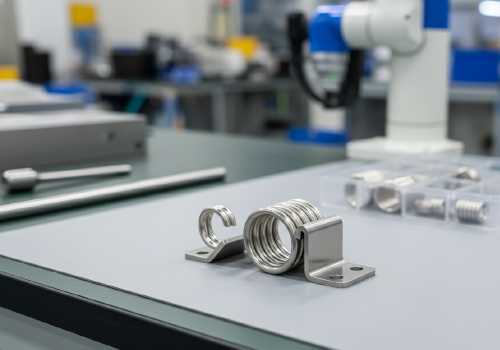
- Hybrid Manufacturing: For parts like custom clips or brackets, we combine CNC machining (for holes/profiles) with precision bending to leverage 301's ductility and strength.
- Surface Finishing: We offer electropolishing and passivation to enhance the corrosion resistance of 301, making it suitable for exposed applications.
Advantages of CNC Machining 301
| Advantage | Detailed Description | Key Benefit |
| High Work-Hardening Rate | Gains strength rapidly during cold working or machining. | Allows for the production of high-strength, thin-walled parts. |
| Spring Properties | Retains elasticity and resists permanent deformation under load. | The ideal material for springs, clips, fasteners, and flexible contacts. |
| Good Ductility | In the annealed state, it is highly formable. | Suitable for complex drawn or formed parts that are subsequently machined. |
| Wear Resistance | Harder surface than 304 due to cold working. | Better resistance to scratching and abrasion in moving assemblies. |
| Cost-Effective Strength | Achieves high strength without the need for post-process heat treatment (unlike 17-4 PH). | Economical for high-volume structural components. |
Technical Parameters & Material Standards
We process 301 in different tempers to match the required strength:
| Grade Category | Condition | Characteristics & Ideal Uses |
| 301 Annealed | Soft State | Characteristics: Non-magnetic, soft, and ductile. Maximum formability. Can be hardened by subsequent machining or forming. Uses: Deep drawn parts, complex stamped and machined components. |
| 301 1/4 Hard to Full Hard | Cold Worked | Characteristics: Material is cold-rolled to specific tensile strengths. Magnetic. High yield strength and spring-back. Uses: Springs, structural clips, automotive trim, wiper blade supports, diaphragms. |
CNC Machining Guidelines 301
- Work Hardening: This is the biggest challenge. The tool must cut and never rub. We use aggressive feed rates to get under the work-hardened layer from the previous pass.
- Tooling: Carbide tools are mandatory. High-speed steel tools will dull instantly.
- Heat Generation: 301 generates significant heat. High-pressure coolant is critical to prevent thermal expansion and tool failure.
- Distortion: Machining heavily cold-worked 301 (Full Hard) can release internal stresses, causing warping. We use stress-relieving cycles or symmetrical machining to control flatness.
Application Scenarios
- Automotive: Wheel covers, wiper blade holders, seat belt components, trim molding.
- Rail & Transport: Structural car body parts, subway car panels (high strength-to-weight).
- Industrial: Conveyor belts, springs, clamps, clips, fasteners.
- Consumer Electronics: Battery contacts, flexible structural frames within devices.
- Aircraft: Structural parts requiring higher strength than 304 but lower cost than titanium.
Physical Properties Table
Comparison: Annealed vs. Full Hard (Showing the massive strength gain):
| Property | SS 301 (Annealed) | SS 301 (Full Hard) | Unit |
| Density | 7.90 | 7.90 | g/cm³ |
| Tensile Strength | 515 | 1275 (Min) | MPa |
| Yield Strength | 205 | 965 (Min) | MPa |
| Elongation | 40 | 8 | % |
| Magnetic | No | Yes | - |
| Corrosion Resistance | Good | Good | - |

Request Your DFM & Quote – Upload Your Drawings
ㆍFill in your requirements and upload your 2D&3D file, we will feedback your project quotation and DFM within 24 hours.ㆍFile types: STEP, STP, IGES, IGS, SLDPRT, 3DM, SAT or X_T files File size: < 128 MB Part size: < 1500*1500*1500 mm
ㆍPrivacy: We respect your privacy. Here you can find an example of a non-disclosure agreement. By submitting this form, you agree to our terms & conditions and privacy policy.
ㆍPrivacy: We respect your privacy. Here you can find an example of a non-disclosure agreement. By submitting this form, you agree to our terms & conditions and privacy policy.