
Stainless Steel 304/304L CNC Machining Material
Stainless Steel 304 (and its low-carbon variant 304L) is the most widely used austenitic stainless steel in the world. Known as "18-8" stainless due to its composition of 18% chromium and 8% nickel, it offers an outstanding balance of corrosion resistance, weldability, and formability. At JUCHENG, machining stainless steel is a core competency. We understand that 304 tends to work-harden if not processed correctly. Our facility utilizes rigid CNC setups, high-torque spindles, and specialized tooling strategies to deliver precision 304/304L components without thermal distortion or surface defects.
Stainless Steel 304/304L
JUCHENG's 304/304L Machining Capabilities
Processing austenitic stainless steel requires overcoming its tendency to be "gummy" and work-harden. We offer:
- Work-Hardening Control: Our programmers utilize constant-load tool paths and sharp cutting strategies to ensure the tool always cuts beneath the work-hardened zone, ensuring dimensional stability.
- Passivation Services: Machining can embed free iron on the surface. We provide in-house Citric or Nitric Acid Passivation to remove contaminants and maximize corrosion resistance.
- Polishing & Finishing: From standard Ra 1.6 machined finishes to Ra 0.4 electropolished surfaces for sanitary applications, we meet strict aesthetic requirements.
- Dual Certification: We stock material that is often dual-certified as 304/304L, giving you the strength of 304 with the welding benefits of 304L.
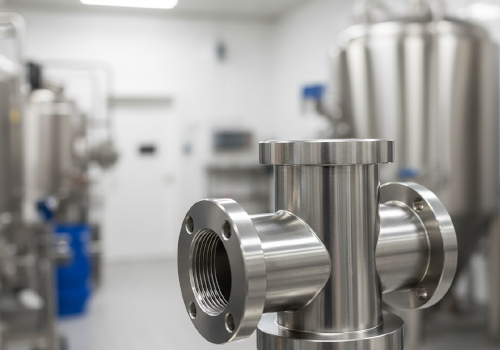
Advantages of CNC Machining 304/304L
| Advantage | Detailed Description | Key Benefit |
| Excellent Corrosion Resistance | Resists oxidation in most architectural, industrial, and chemical environments. | Ideal for parts exposed to moisture, acids, or outdoor elements. |
| Hygienic Properties | Non-porous surface is easy to clean and does not support bacterial growth. | The standard choice for food processing, dairy, and brewing equipment. |
| Superior Weldability | Can be welded by all standard fusion methods. 304L prevents carbide precipitation. | Perfect for machined fittings that will be welded into tanks or piping systems. |
| Good Toughness | Retains toughness even at cryogenic temperatures. | Suitable for low-temperature industrial applications. |
| Non-Magnetic | Generally non-magnetic in the annealed condition (may become slightly magnetic after cold working). | Suitable for electronic housings and medical sensors. |
Technical Parameters & Material Standards
We distinguish between the standard and low-carbon grades:
| Grade Category | Ideal Applications | Characteristics |
| Stainless Steel 304 | Machined fasteners, kitchen equipment, architectural hardware, springs, brackets not requiring heavy welding. | Standard Grade. Higher carbon content (~0.08%). Slightly higher strength than 304L. Excellent corrosion resistance but susceptible to "weld decay" (intergranular corrosion) in heavy welded sections. |
| Stainless Steel 304L | Welded tanks, pipe fittings, chemical containers, nuclear components, heavy-gauge industrial parts. | Low Carbon Grade. Lower carbon content (~0.03%). Eliminates carbide precipitation during welding. Slightly lower yield strength but superior corrosion resistance after welding. |
CNC Machining Guidelines for 304
- Speeds and Feeds: 304 requires slower speeds and higher feeds than aluminum to prevent work hardening. Dwelling (tool staying in one spot) must be avoided.
- Coolant: High-pressure flood coolant is mandatory to reduce heat generation, which is a primary cause of tool failure and part distortion.
- Tooling: We use TiAlN (Titanium Aluminum Nitride) coated carbide tools which provide heat resistance and lubricity.
- Surface Contamination: We designate specific machines or coolant tanks for stainless steel to avoid cross-contamination with carbon steel particles, which can cause rust spots.
Application Scenarios
- Food & Beverage: Valves, dispensing nozzles, mixing shafts, conveyor components (FDA compliant).
- Medical: Surgical instrument handles, hospital trays, equipment housings.
- Industrial: Pressure vessels, flanges, fasteners, heat exchangers.
- Architecture: Glass spiders/fittings, handrail brackets, decorative panels.
- Automotive: Exhaust system flanges, trim components.
Physical Properties Table
Comparison of 304 vs 304L:
| Property | SS 304 | SS 304L | Unit |
| Density | 8.00 | 8.00 | g/cm³ |
| Tensile Strength | 515 | 485 | MPa |
| Yield Strength | 205 | 170 | MPa |
| Elongation | 40 | 40 | % |
| Hardness (Brinell) | 201 | 201 | HB |
| Carbon Content | Max 0.08% | Max 0.03% | - |
| Machinability | 45% | 45% | (Ref: B1112=100%) |

Request Your DFM & Quote – Upload Your Drawings
ㆍFill in your requirements and upload your 2D&3D file, we will feedback your project quotation and DFM within 24 hours.ㆍFile types: STEP, STP, IGES, IGS, SLDPRT, 3DM, SAT or X_T files File size: < 128 MB Part size: < 1500*1500*1500 mm
ㆍPrivacy: We respect your privacy. Here you can find an example of a non-disclosure agreement. By submitting this form, you agree to our terms & conditions and privacy policy.
ㆍPrivacy: We respect your privacy. Here you can find an example of a non-disclosure agreement. By submitting this form, you agree to our terms & conditions and privacy policy.