
D-Series Cold Work Tool Steel Machining
When cutting, stamping, or forming metal, you need a tool material that is harder and tougher than the workpiece. D-Series Tool Steels (High-Carbon, High-Chromium) are engineered exactly for this purpose. Among them, AISI D2 is the global industry standard for cold work applications, renowned for its exceptional wear resistance and stability during heat treatment. At JUCHENG, we don't just machine soft steel; we specialize in Hard Milling and Precision Grinding of tool steels. From manufacturing complex progressive die components to heavy-duty shear blades, we deliver hardened parts (60-62 HRC) that maintain a sharp edge over millions of cycles.
Tool Steel D Series
JUCHENG's Tool Steel Fabrication Capabilities
Working with tool steel requires a different approach than structural alloys. We offer:
- Hard Milling: We utilize rigid CNC machines and advanced coating technologies to machine D2 steel after it has been hardened, ensuring zero heat-treat distortion errors for critical features.
- EDM & Wire Cutting: For intricate die shapes and sharp internal corners that cannot be milled, we use Electrical Discharge Machining (EDM) to erode the hardened steel with micron-level precision.
- Precision Grinding: We provide surface grinding and cylindrical grinding to achieve perfectly flat and round bearing surfaces with tight tolerances (+/- 0.005mm).
- Vacuum Heat Treatment: We partner with certified heat treaters to perform Vacuum Hardening and Tempering, ensuring the steel reaches maximum hardness without surface oxidation or scaling.
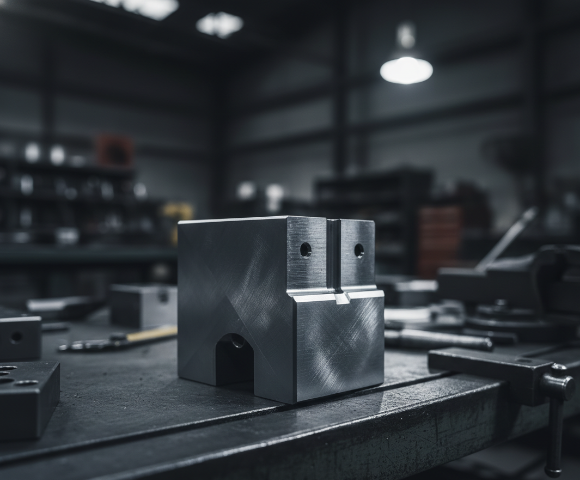
Advantages of CNC Machining D-Series Steel
| Advantage | Detailed Description | Key Benefit |
| Extreme Wear Resistance | The high volume of chromium carbides in the microstructure resists sliding wear and abrasion. | Essential for stamping punches, dies, and slitting cutters that rub against metal. |
| High Compressive Strength | Resists deformation under heavy loads without cracking. | Ideal for forming dies and coining tools. |
| Deep Hardenability | Can be hardened uniformly throughout large cross-sections. | Ensures the core of a large die block is just as strong as the surface. |
| Low Distortion (D2) | D2 is an "Air Hardening" steel. It distorts very little during cooling compared to water/oil quench steels. | Perfect for intricate tooling where size change during hardening must be minimized. |
| Edge Retention | Holds a razor-sharp cutting edge for extended periods. | The preferred choice for industrial knives and shear blades. |
Technical Parameters & Material Standards
We process the three primary D-Series grades, each with specific hardening characteristics:
| Grade Category | Specification | Characteristics & Ideal Uses |
| AISI D2 | Air Hardening | Characteristics: The most popular cold work steel. High Carbon (1.5%), High Chrome (12%). Air hardening results in minimal distortion. Excellent balance of wear resistance and toughness. Uses: Stamping dies, forming rolls, punches, shear blades, food processing knives. |
| AISI D3 | Oil Hardening | Characteristics: Similar to D2 but must be quenched in oil. Offers slightly higher wear resistance but lower toughness and greater risk of distortion during hardening. Uses: Brick mold liners, high-wear ceramic molds, simple-shape shear blades. |
| AISI D4 | Air Hardening | Characteristics: Higher Molybdenum content than D2/D3. Offers deep hardenability for very large sections. Maintains hardness better if the tool gets hot. Uses: Large drawing dies, thread rolling dies, long shear knives. |
CNC Machining Guidelines for Tool Steel
- Machine Annealed: We perform 90% of the material removal while the steel is in the Annealed state (approx. 20-25 HRC).
- Finish Hard: We leave a small stock allowance (0.2mm) and finish-machine or grind the part after Heat Treatment (60-62 HRC) to achieve final dimensions.
- EDM Warning: If EDM is used, the "white layer" (re-cast layer) must be removed by polishing, as it is brittle and can cause surface cracking.
- No Welding: D-Series steels are extremely difficult to weld without cracking. We recommend mechanical assembly or using insertable components.
Application Scenarios
- Metal Stamping: Progressive die sets, blanking punches, forming pads.
- Industrial Cutting: Slitting knives for paper/plastic, guillotine shear blades, scrap choppers.
- Forming: Thread rolling dies, tube bending mandrels, embossing tools.
- Injection Molding: Mold inserts for abrasive glass-filled plastics (where H13 wears out too fast).
- Woodworking: Planer blades and chipper knives.
Physical Properties Table
Comparison: D2 vs D3 (Standard Hardened State):
| Property | AISI D2 (Air Hardened) | AISI D3 (Oil Hardened) | Unit |
| Hardness | 60 - 62 HRC | 58 - 60 HRC | Rockwell C |
| Wear Resistance | Very High | Highest | - |
| Toughness | Medium | Low | - |
| Distortion in HT | Very Low | Medium | - |
| Compressive Strength | 2,200 | 2,000 | MPa |
| Machinability | Difficult | Very Difficult | - |

Request Your DFM & Quote – Upload Your Drawings
ㆍFill in your requirements and upload your 2D&3D file, we will feedback your project quotation and DFM within 24 hours.ㆍFile types: STEP, STP, IGES, IGS, SLDPRT, 3DM, SAT or X_T files File size: < 128 MB Part size: < 1500*1500*1500 mm
ㆍPrivacy: We respect your privacy. Here you can find an example of a non-disclosure agreement. By submitting this form, you agree to our terms & conditions and privacy policy.
ㆍPrivacy: We respect your privacy. Here you can find an example of a non-disclosure agreement. By submitting this form, you agree to our terms & conditions and privacy policy.