
Vacuum Casting vs SLA: Surface Finish Battle
Views: 5 Author: Allen Xiao Publish Time: 2026-02-27 Origin: Site


Presenting a physical prototype to a boardroom of non-technical stakeholders is a high-stakes performance. In these critical moments, the cosmetic fidelity of the hardware often speaks louder than the underlying engineering logic. If the device feels cheap, rattles due to poor fit, or displays visible manufacturing artifacts, the confidence of investors and executives evaporates instantly. This pressure forces mechanical engineers to choose their prototyping methodology with extreme prejudice. When the requirement is absolute aesthetic perfection—surfaces that rival the gloss of a smartphone screen or the clarity of a crystal lens—the debate narrows significantly. It is no longer a question of rough functionality; it becomes a precise standoff between vacuum casting vs 3d printing strategies. Specifically, the battle is fought between the laser-driven precision of Stereolithography (SLA) and the mold-based fidelity of Polyurethane Casting.

Superficially, both vacuum casting vs SLA appear to offer the same value proposition: smooth parts, tight tolerances, and complex geometries. However, scratching beneath the surface reveals two radically different physical realities. One relies on the UV-curing of expensive photopolymers, creating parts that are visually stunning but chemically unstable. The other utilizes a "parasitic" replication process to clone a master pattern into durable, chemically inert thermoset plastics. Choosing the wrong path here is expensive. We have seen countless projects fail validation because an SLA living hinge snapped after three days of exposure to office lighting, or because a cast part was ordered when a single high-resolution print would have sufficed. Jucheng Precision operates both industrial SLA arrays and extensive vacuum casting lines. We do not care which one you choose, as long as it survives your testing protocol. This guide provides the unvarnished technical truth needed to navigate the trade-off between laser resolution and thermoset durability.
content:
Photopolymerization Precision: The Ultimate Master Pattern
Chemical Durability: UV Degradation vs Thermoset Stability
Volume Economics: Scaling High-Fidelity Copies
JUCHENG Synergy: Marrying Lasers with Liquid Silicone
Photopolymerization Precision: The Ultimate Master Pattern
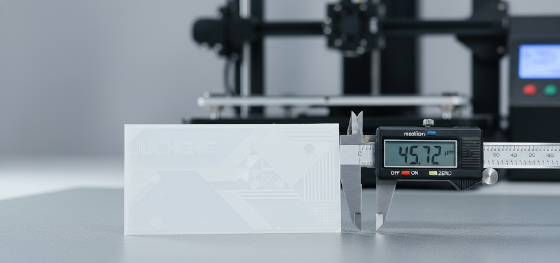
To understand the surface finish advantage of Stereolithography, one must look at the diameter of the tool. In CNC machining, the smallest radius is dictated by the cutter—typically 0.5mm or larger. In FDM printing, it is the nozzle width. In SLA, the "tool" is a focused beam of ultraviolet light, often with a spot size as small as 80 microns. This laser traces the cross-section of the part onto the surface of a liquid photopolymer vat, curing it instantly. The build platform then descends by a single layer thickness—often set to an incredibly fine 0.025mm (25 microns). This vertical resolution is so minute that the "stair-stepping" effect visible on other additive parts is effectively invisible to the naked eye.
This capability makes SLA the undisputed king of "Geometry One." If you need to prototype a micro-fluidic chip with internal channels that are 0.2mm wide, or a jewelry-like consumer product with intricate embossed text, SLA is the only viable option. The resin flows into every void before curing. However, Vacuum Casting operates on a completely different logic. It has no native resolution. The silicone mold is a mirror; it blindly reflects whatever surface it touches. If you machine a master pattern with a rough cutter, the silicone will replicate the tool marks perfectly. Therefore, Vacuum Casting is not a method for *creating* resolution; it is a method for *transferring* it. This is why the two technologies are often partners rather than enemies. We frequently use high-resolution SLA (utilizing specialized resins like Somos WaterShed for smoothness) to create the "Master Pattern." We then invest hundreds of hours hand-sanding and polishing this single printed master to a mirror finish (SPI A2). The silicone mold then captures this perfected surface, allowing us to cast copies that look like injection-molded parts, but the "DNA" of that surface quality originated from the laser.
Chemical Durability: UV Degradation vs Thermoset Stability
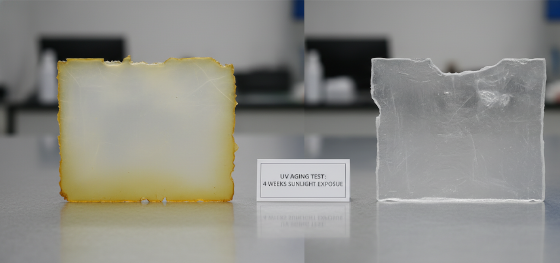
Here lies the trap for the uninitiated engineer. While an SLA part looks pristine the moment it is washed and cured, it is fighting a losing battle against the environment. The fundamental chemistry of SLA resins relies on photo-initiators that react to UV light. The problem is that this reaction never truly stops. If you place a standard white SLA prototype on a windowsill or under bright fluorescent office lights, the UV radiation continues to drive the cross-linking process. This is known as "creep cure." Over a period of weeks, the polymer chains become tighter and tighter until the material loses all ductility. A snap-fit tab that worked perfectly on Day 1 will shatter like glass on Day 30. Furthermore, many photopolymers are hygroscopic—they love water. In a humid environment, a thin-walled SLA housing can absorb moisture, swell, and warp out of tolerance without any external load.
Vacuum Casting polyurethanes are engineered to destroy this volatility. The chemistry here is "Thermoset," meaning heat sets the bond permanently. When we mix the Isocyanate and Polyol components of a resin like Hei-Cast 8150, they undergo an exothermic reaction that forms a dense, stable 3D network. Once cured, the material is dead inert. It does not react to sunlight. It does not absorb water. A clear lens cast in Axson PX 5212 will maintain its water-white transparency for years, whereas a clear SLA resin (like Accura 60) will inevitably turn a sickly yellow or amber color as it oxidizes. If your validation protocol involves outdoor testing, high-humidity environmental chambers, or long-term lifecycle user trials, relying on printed SLA resins is a liability. You need the chemical stability of a cured polyurethane to ensure that a failure in the lab is due to your design, not the degradation of your prototype material.
Volume Economics: Scaling High-Fidelity Copies
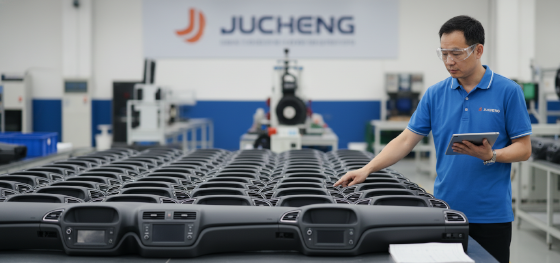
Procurement strategies often fail when engineers attempt to scale a "quantity one" technology into a "quantity fifty" production run. The financial architecture of Stereolithography is linear and unforgiving. Printing a single high-resolution cosmetic prototype might consume twelve hours of machine time and $100 worth of proprietary photopolymer resin. If the project manager suddenly demands thirty identical units for a global sales conference, the additive equation becomes a nightmare. The printer farm does not offer a bulk discount; it simply multiplies that twelve-hour cycle and that $100 material cost by thirty. The machine is tied up for weeks, and the resin bill skyrockets into the thousands. There is absolutely zero "economy of scale" because the laser must trace every single vector for every single part, regardless of how many you order.
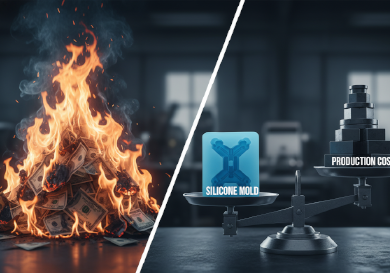
Silicone replication thrives precisely where the additive cost curve becomes unsustainable. The economics of vacuum casting function on an amortization model similar to injection molding, but with a much lower entry barrier. The initial capital requirement heavily penalizes the first unit, as technicians must meticulously fabricate the master pattern (often via SLA or CNC) and pour the RTV silicone block. This initial "tooling" phase might cost a few hundred dollars. However, once that flexible tool is sliced open and validated, the financial dynamics violently invert. Pouring the second, tenth, or fiftieth polyurethane copy costs a fraction of the corresponding SLA print—often 60% to 80% cheaper per unit. Furthermore, the silicone tool operates offline, freeing up critical additive machinery. A single mold can produce four parts per day. By running multiple molds in parallel, Jucheng Precision can seamlessly cast dozens of flawlessly textured, mechanically robust units in a matter of days. This capability completely overwhelms the output capacity and unit economics of an isolated laser bed, making casting the only logical fiscal choice for quantities between 10 and 100.
JUCHENG Synergy: Marrying Lasers with Liquid Silicone
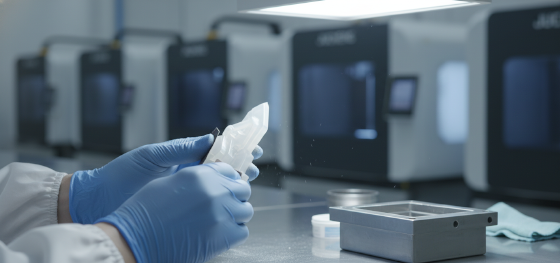
The most successful hardware prototypes are rarely the product of a single machine; they are the result of strategic integration. Amateurs debate which machine to purchase; elite manufacturing partners utilize every tool in the shed to eliminate blind spots. Jucheng Precision recognizes that the ultimate prototype is often forged through a "Hybrid Protocol." We house industrial-grade SLA systems running premium resins alongside highly controlled vacuum casting laboratories equipped with massive degassing chambers. We eliminate vendor bias by refusing to restrict your design to a single technological philosophy. We are not just a print shop; we are a comprehensive manufacturing solution provider.
Executing complex geometric replication often triggers our specific "SLA-Master-Cast-Copy" workflow. If your geometry is too organic for CNC machining—think of a complex anatomical model, a stylized VR headset, or an automotive lattice grill—we immediately deploy our SLA systems to print a hyper-accurate, high-resolution master pattern. This is not the end product; it is the "DNA." Our expert finishers then painstakingly hand-polish this printed artifact to a mirror finish (SPI A2 equivalent) to seal any micropores and remove the faintest laser steps. This perfected master is then submerged into premium RTV silicone. We effectively extract the extreme geometric freedom of the laser and permanently transfer it into the durable, UV-stable reality of thermoset polyurethane. This hybrid approach gives you the best of both worlds: the impossible geometry of 3D printing with the material durability and batch economics of injection molding. Stop compromising between resolution and toughness. Leverage JUCHENG’s integrated capability to deliver prototypes that dominate the boardroom and survive the testing laboratory. Contact our engineering team today, and let us determine the exact physics required to bring your vision to market.


ㆍPrivacy: We respect your privacy. Here you can find an example of a non-disclosure agreement. By submitting this form, you agree to our terms & conditions and privacy policy.