
Teflon vs PEEK: When to Use for High-Temp CNC Parts?
Views: 4 Author: Allen Xiao Publish Time: 2025-10-16 Origin: Site


Procurement engineers hemorrhage massive project budgets when misidentifying engineered plastics during the CAD prototyping phase. Specifying a soft fluoropolymer for a high-load structural gear guarantees immediate catastrophic mechanical failure during early kinetic testing. Material science rigidly dictates the absolute operational boundary of every custom machined component.
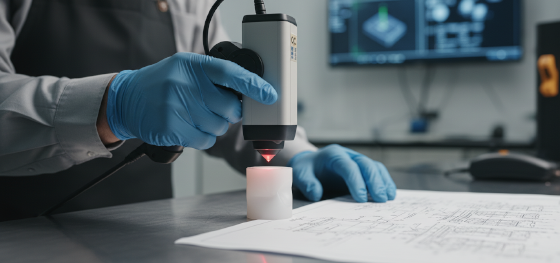
Selecting between Teflon (PTFE) and Delrin (POM) represents the ultimate structural crossroads for non-metallic CNC fabrication. These two industrial plastics dominate the manufacturing floor but operate under entirely hostile physical paradigms. One offers extreme chemical invincibility and zero friction, while the other provides the rigid skeletal backbone required for heavy rotary torque.
Mastering this specific material decision matrix eliminates hidden secondary machining expenses. Fabricators must brutally evaluate cold flow deformation, extreme thermal expansion limits, and raw billet costs. Precision hardware success relies strictly on matching the molecular polymer density to the exact mechanical environment.
content:
Teflon vs Delrin: How Do Mechanical Properties Compare?
When Should You Use Teflon for Extreme CNC Parts?
When MUST You Avoid Teflon in Structural Assemblies?
Why Does CNC Machining Teflon Destroy Micron Tolerances?
What Are the True Cost Breakdowns for Both Polymers?
How Does Jucheng Optimize Plastic Workflows in Shenzhen?
What Are the Most Critical Teflon Machining FAQs?
Teflon vs Delrin: How Do Mechanical Properties Compare?
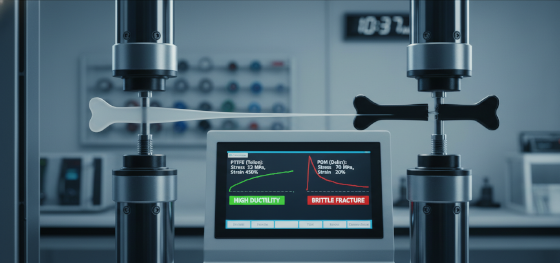
Teflon (Polytetrafluoroethylene) delivers the lowest coefficient of friction of any known solid material but completely lacks the structural rigidity and tensile strength native to Delrin acetal resins.
Delrin acts almost exactly like a lightweight metal during CNC milling operations. The highly crystalline polyoxymethylene (POM) structure allows machinists to carve sharp, aggressive gear teeth that effortlessly transfer kinetic power without snapping. It provides unmatched dimensional stability for snap-fits and heavy-duty industrial fasteners.
Teflon operates on the exact opposite end of the mechanical spectrum. It behaves like a highly compressed, ultra-slippery wax. While it survives extreme thermal baking up to 260°C and brutally repels aggressive industrial acids, you can easily gouge its soft surface with a human fingernail. Engineers trade pure physical muscle for ultimate chemical invincibility.
| Mechanical Metric | Teflon (PTFE) | Delrin (Acetal POM) | Engineering Impact |
|---|---|---|---|
| Tensile Strength | ~25 MPa | ~70 MPa | Delrin dominates heavy structural loads |
| Chemical Resistance | Absolute (Invincible) | Moderate (Fails in strong acids) | Teflon survives semiconductor acid baths |
| Max Operating Temp | 260°C (500°F) | 90°C (194°F) | Delrin melts under high thermal exhaust |
| Machinability | Poor (Soft, stringy chips) | Excellent (Crisp, metal-like chips) | Delrin holds tight CNC tolerances effortlessly |
When Should You Use Teflon for Extreme CNC Parts?
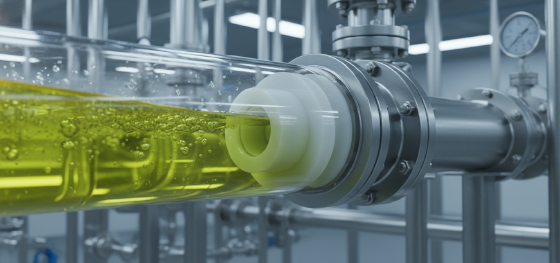
Specify PTFE exclusively for fluid handling manifolds, cryogenic aerospace seals, and semiconductor processing equipment where aggressive chemical corrosion destroys all other polymers instantly.
Nothing attacks Teflon. Submerging a custom machined PTFE manifold into a boiling vat of sulfuric acid yields absolutely zero chemical degradation. The carbon-fluorine molecular bonds remain incredibly stable, refusing to react with external industrial solvents or atmospheric moisture. This extreme inertness makes it the undisputed king of hazardous fluid handling.
Automotive engineers actively exploit its legendary low friction coefficient for dry-running kinetic applications. Fabricating highly specialized guide rails or internal piston rings from PTFE allows robotic mechanisms to slide seamlessly without requiring external liquid lubrication. You engineer the lubricant directly into the physical geometry.
When MUST You Avoid Teflon in Structural Assemblies?
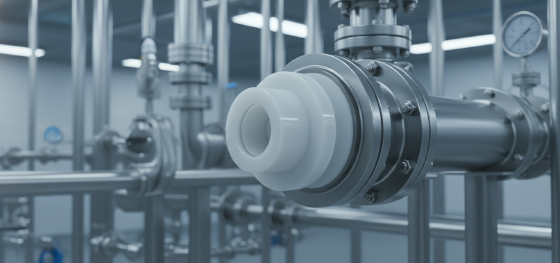
Deploying PTFE for load-bearing brackets or high-torque drive gears guarantees catastrophic dimensional failure through an unstoppable physical phenomenon known as cold flow.
Cold flow, or mechanical creep, forces the soft plastic to permanently squish and deform when subjected to continuous compressive pressure at room temperature. If technicians aggressively torque a heavy steel bolt down onto a raw Teflon washer, the polymer acts like slow-moving dough. It eventually oozes outward, destroying the fastener's holding tension entirely.
You must immediately upgrade to Delrin or PEEK whenever the blueprint demands rigid structural integrity. Attempting to carve fine mechanical threads into PTFE yields disastrous results; the soft threads will instantly strip and shear out the moment any mating screw applies rotational force.
Why Does CNC Machining Teflon Destroy Micron Tolerances?
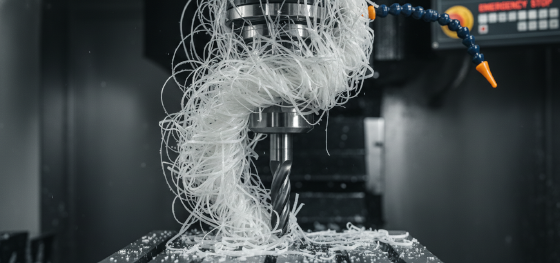
The extreme softness and rapid thermal expansion of fluoropolymers physically prevent standard multi-axis CNC machines from hitting and holding tight aerospace press-fit tolerances.
Machinists battle severe localized heat buildup during rapid spindle traversal. As the carbide end mill shears the plastic, the PTFE physically swells and expands toward the cutting tool. Operators measure the freshly cut part and achieve a perfect dimension, but once the plastic cools to ambient temperature, the geometry shrinks violently out of compliance.
Furthermore, PTFE produces incredibly long, tough, and stringy chips that refuse to snap cleanly. These unbreakable ribbons whip violently around the spinning spindle, binding the cutting flutes and aggressively scoring the delicate surface finish of the workpiece. Mastering this polymer requires massive air-blast cooling and extremely sharp, high-positive rake tooling.
What Are the True Cost Breakdowns for Both Polymers?
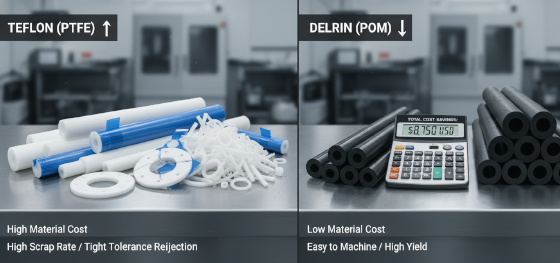
Raw PTFE billets cost exponentially more than acetal resins, and the severe difficulty in maintaining CNC tolerances drives the overall batch scrap rate dangerously high.
Procuring standard Delrin rods minimizes your upfront bill of materials. The stiff plastic cuts aggressively at maximum machine feed rates, generating crisp chips and pristine surface finishes. This ultra-fast cycle time drastically lowers the machine hourly rate, rendering POM incredibly economical for high-volume rapid manufacturing.
Specifying pure Teflon immediately incinerates procurement budgets. The raw chemical resin is expensive to synthesize and mold into solid billets. When programmers slow down the CNC spindle feeds to prevent thermal expansion melting, the cycle time triples. Financial survival demands restricting PTFE strictly to zones where its chemical invincibility is absolutely mandatory.
How Does Jucheng Optimize Plastic Workflows in Shenzhen?
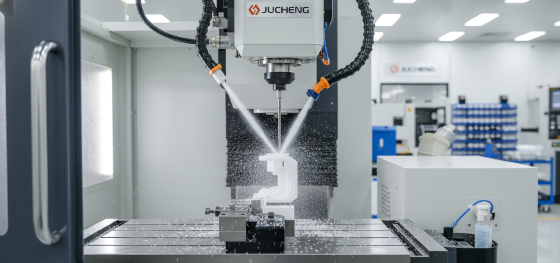
Operating deep within the Shenzhen precision manufacturing hub, Jucheng deploys dedicated climate-controlled milling zones and specialized non-contact metrology to eliminate polymer tolerance failures.
Navigating [2026] global hardware procurement requires eradicating analog measurement errors. Squeezing a soft PTFE prototype with standard mechanical calipers crushes the material, delivering mathematically flawed inspection data. We utilize advanced optical CMMs to verify complex plastic geometries using lasers, guaranteeing zero physical deflection.
Our engineering teams aggressively execute Free DFM reviews on your CAD geometry. If you over-specify Teflon for a simple electronic enclosure, our engineers instantly pivot the blueprint to Delrin or ABS to slash your machining costs. Backed by strict ISO9001:2015 protocols, our No MOQ policy empowers highly agile hardware prototyping.
What Are the Most Critical Teflon Machining FAQs?
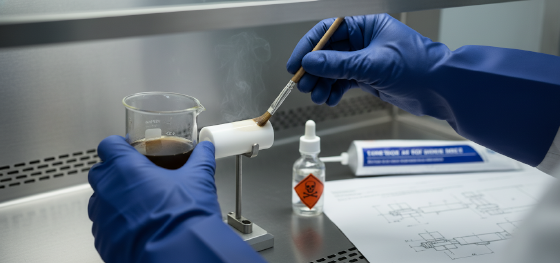
Resolving hardcore chemical and mechanical vulnerabilities prevents catastrophic assembly failures during the deployment of custom industrial plastics.
Can you bond or glue Teflon to other structural components?
No, not in its raw state. PTFE's legendary non-stick property violently repels all industrial adhesives and epoxies. To successfully glue this material, technicians must subject the surface to an extremely dangerous chemical process using a sodium-ammonia etching solution to physically rip the fluorine atoms away, creating a bondable micro-texture.
Is it dangerous to machine Teflon at extremely high spindle speeds?
Yes. While PTFE withstands normal operating temperatures up to 260°C, extreme friction from an overheating end mill can push the localized temperature past 300°C. At this critical threshold, the polymer begins to chemically decompose, emitting highly toxic fluoropolymer fumes that are incredibly hazardous to CNC operators.
Can you add glass or carbon fiber to improve Teflon's rigidity?
Yes. Material scientists frequently blend 15% to 25% glass fiber directly into the PTFE matrix. This specialized composite drastically reduces the notorious cold flow (creep) phenomenon and significantly boosts compressive strength, while sacrificing only a fractional amount of its native low-friction capabilities.


ㆍPrivacy: We respect your privacy. Here you can find an example of a non-disclosure agreement. By submitting this form, you agree to our terms & conditions and privacy policy.