
Axson PX527 - Vacuum Casting ABS Material
Axson PX527 is a premium, high-temperature epoxy resin core to advanced vacuum casting workflows, primarily for creating durable, heat-resistant molds and master patterns. Its exceptional thermal stability, dimensional accuracy, and rigidity make it ideal for short-run production tooling and demanding applications in automotive, aerospace, and industrial manufacturing. Its brittleness, complex processing requiring post-cure, and higher cost are key limitations compared to polyurethane casting resins. It excels where heat resistance and dimensional fidelity are paramount.
Axson PX527
Basic Characteristics & Composition
Material Type: Two-component (2K), thermosetting epoxy resin system.
Primary Purpose: Engineered for creating high-temperature-resistant master patterns, production molds (short-run tooling), jigs, fixtures, and functional prototypes requiring exceptional thermal stability.
Key Properties:
Primary Purpose: Engineered for creating high-temperature-resistant master patterns, production molds (short-run tooling), jigs, fixtures, and functional prototypes requiring exceptional thermal stability.
Key Properties:
- Exceptional Heat Resistance: Very high Heat Deflection Temperature (HDT) - typically ~200-220°C (392-428°F) at 0.45 MPa / 66 psi. Usable continuously at 150-180°C (302-356°F).
- Extremely Low Shrinkage: Near-zero shrinkage during cure (<0.05%), critical for dimensional accuracy in molds and masters.
- High Rigidity & Hardness: Very high modulus, excellent compressive strength, Shore D hardness >85.
- Excellent Dimensional Stability: Maintains shape and accuracy under thermal cycling and mechanical load.
- Good Chemical Resistance: Resists many oils, coolants, and chemicals encountered in molding environments.
- Fine Surface Reproduction: Captures intricate details from the original model.
- Mix Ratio: Typically 100A : 30B by weight (Always consult the Technical Data Sheet - TDS).
- Cure Profile: Requires elevated temperature post-cure (e.g., 70-80°C / 158-176°F for several hours or overnight) to achieve full thermal properties. Demold time at room temp is longer than PU resins (often 16-24 hrs), post-cure essential.
- Viscosity: Moderate viscosity paste-like consistency (especially Part B), requires careful mixing and vacuum degassing.
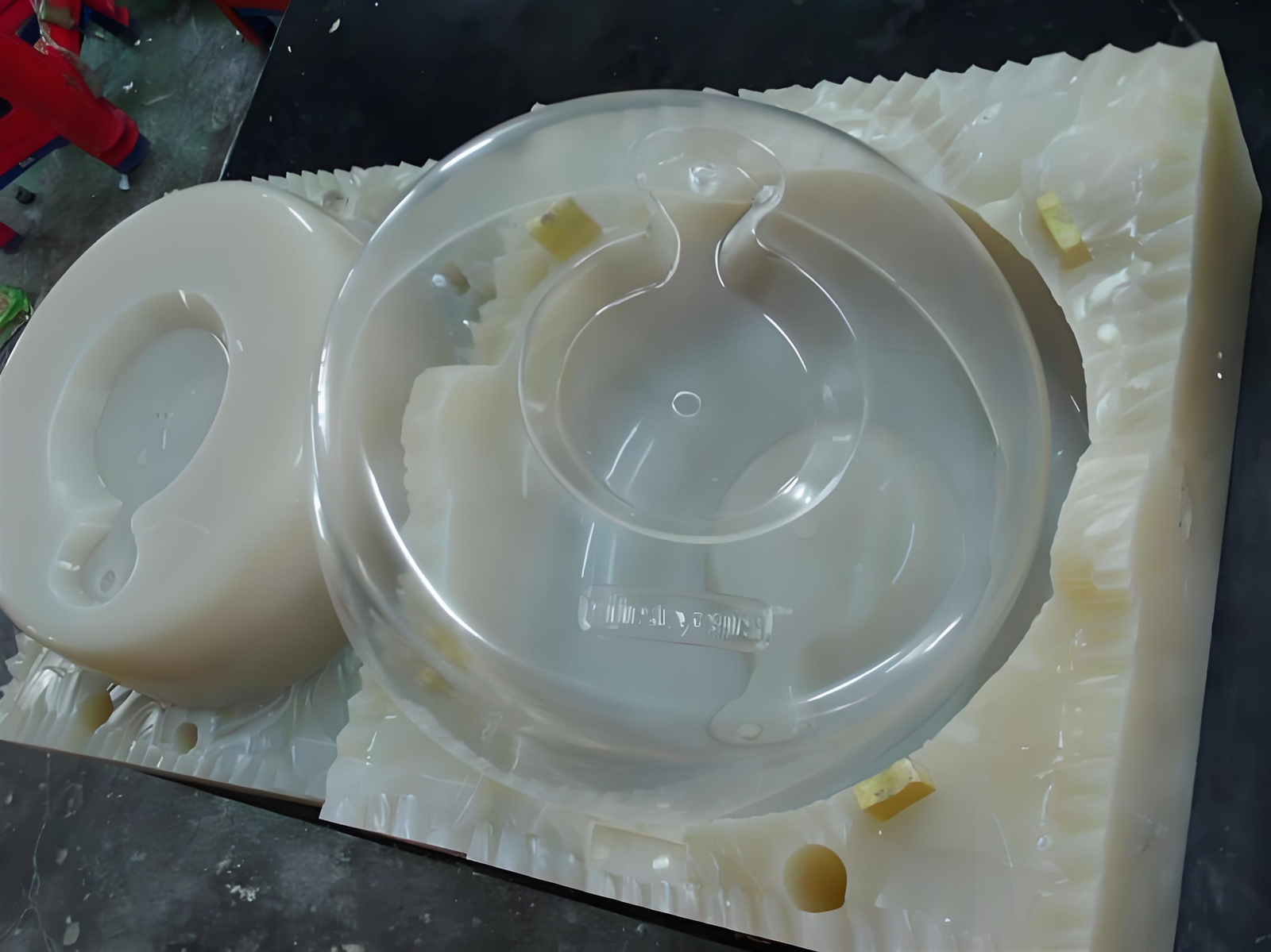
Key Technical Parameters
| PHYSICAL PROPERTIES | ||||
| PX 527 | PX 527 | |||
| Composition | ISOCYANATE | POLYOL | MIXING | |
| Mixing ratio by weight | 100 | 55 | ||
| Aspect | liquid | liquid | liquid | |
| Colour | transparent | bluish | transparent | |
| Viscosity at 25°C (mPa.s) | BROOKFIELD LVT | 300 | 700 | 700 |
| Specific gravity at 25°C Specific gravity at 23°C | ISO 1675 :1975 ISO 2781 :1988 | 1.19 - | 1.10 - | - 1.15 |
| Pot life at 25°C on 100g (min.) | Gel Timer TECAM | 4 | ||
PROCESSING CASTING PROCESSING BY MACHINE
• Heat both parts (Isocyanate and Polyol) at 23°C in case of storage at lower temperature.
• Weigh both 2 parts.
• Mix for 1 minute minimum after degassing for 10 minutes under vacuum.
• Cast under vacuum in silicone mould previously heated at 70°C.
• Remove from the mould after 45 minutes minimum at 70°C
For pigmentation of 527, add pigments like CP colours only in Polyol component.
• Weigh both 2 parts.
• Mix for 1 minute minimum after degassing for 10 minutes under vacuum.
• Cast under vacuum in silicone mould previously heated at 70°C.
• Remove from the mould after 45 minutes minimum at 70°C
For pigmentation of 527, add pigments like CP colours only in Polyol component.
HANDLING PRECAUTIONS
Normal health and safety precautions should be observed when handling these products :
• Ensure good ventilation
• Wear gloves, safety glasses and waterproof clothes.
For further information, please consult the product safety data sheet.
Normal health and safety precautions should be observed when handling these products :
• Ensure good ventilation
• Wear gloves, safety glasses and waterproof clothes.
For further information, please consult the product safety data sheet.
| MECHANICAL PROPERTIES at 23°C | |||
| Hardness | ISO 868 : 2003 | Shore D1 / D15 | 80 |
| Tensile strength | ISO 527 : 1993 | MPa | 73 |
| Elongation at break | ISO 527 : 1993 | % | 13 |
| Flexural modulus | ISO 178 : 2001 | MPa | 2600 |
| Flexural strength | ISO 178 : 2001 | MPa | 117 |
| Impact strength (CHARPY) Unnotched specimens | ISO 179/1eU : 1994 | kJ/m2 | > 100 |
| THERMAL AND SPECIFIC PROPERTIES | |||
| Glass transition temperature (Tg) | ISO 11359 : 2002 | °C | 90 |
| Deflection temperature (HDT) | ISO 75 : 2004 | °C | 80 |
| Linear shrinkage (aluminium mould) | - | mm/m | N.C |
| Maximal casting thickness | - | mm | 5 |
| Demoulding time at 70°C | - | min | 45 |
STORAGE CONDITIONS
Shelf life is 6 months for Isocyanate and 12 months for Polyol in a dry place and in original unopened containers, at a temperature between 15 and 25° C. Any open can must be tightly closed under dry nitrogen blanket.
Application Scenarios & Fields
Primary Use 1: Production Molds (Short-Run Tooling): Creating epoxy-based molds for processes like polyurethane casting, low-pressure injection molding (e.g., PA, PP, POM), composite layup, wax injection (for investment casting), and silicone molding. Used when metal tooling is too expensive or lead time is critical.
Primary Use 2: High-Temp Master Patterns & Models: Patterns for silicone mold making that must withstand repeated casting cycles without distortion. Models for thermoforming or composite tooling masters.
Key Industries & Applications:
Primary Use 2: High-Temp Master Patterns & Models: Patterns for silicone mold making that must withstand repeated casting cycles without distortion. Models for thermoforming or composite tooling masters.
Key Industries & Applications:
- Automotive: Under-hood components (ducts, housings), fluid reservoir prototypes, jigs/fixtures for assembly/testing, composite part tooling.
- Aerospace: Prototype ducting, brackets, composite layup tools, high-temp check fixtures.
- Industrial Equipment: Molds for casting polyurethane parts (gaskets, seals, dampers), jigs/fixtures exposed to heat, durable gauges.
- Consumer Goods: Molds for casting high-detail or heat-resistant components.
- Foundry: Patterns for investment casting (wax injection molds).
- General Manufacturing: Short-run production tooling, durable check fixtures, master models.
Vacuum Casting Process Adaptability:
Adapted for Specific Roles: Primarily used within the vacuum casting ecosystem for making the molds (tooling) or high-temp master patterns, not typically for casting end-use parts like PU resins (e.g., PX215).
Key Adaptations:
Key Adaptations:
- Vacuum Degassing Essential: Critical to eliminate bubbles in the thick paste, ensuring void-free molds/masters.
- Master Pattern Requirement: Requires a high-quality master pattern (often CNC machined or 3D printed) to create the mold cavity.
- Silicone Molding Compatibility: Excellent for making the initial silicone molds used to cast PX527 tooling blocks or masters.
- Longer Process Time: Significantly slower than PU casting due to longer demold and mandatory post-cure.
Advantages:
- Unmatched Heat Resistance: Superior thermal stability for an epoxy casting resin, enabling use in demanding molding environments.
- Exceptional Dimensional Stability & Accuracy: Near-zero shrinkage ensures molds/masters retain precise dimensions.
- High Rigidity & Durability: Creates strong, stiff molds and masters resistant to deformation under pressure and temperature.
- Excellent Detail Reproduction: Captures fine features and textures from the master pattern.
- Good Chemical Resistance: Withstands exposure to many molding materials and shop fluids.
- Suitable for Short-Run Production Molds: Cost-effective alternative to metal tooling for low to medium volumes (50-500+ parts, depending on material molded).
- Machinable: Can be machined, drilled, and tapped after curing.
Limitations:
- Brittleness: Like most epoxies, it lacks impact toughness and is prone to chipping/cracking if dropped or impacted (unlike tougher PUs like PX215).
- Complex & Slow Processing: Requires meticulous mixing, vacuum degassing, longer room temp cure, and mandatory thermal post-cure for full properties. Not suitable for quick-turn prototypes.
- High Viscosity (Paste): Handling and degassing are more challenging than low-viscosity PU resins; flow into very thin sections can be difficult.
- Not for End-Use Functional Parts (Typically): Its brittleness and primary formulation make it less ideal than PU resins for simulating production plastics in final prototypes/parts.
- Higher Cost: Generally more expensive per unit volume than standard PU casting resins.
- UV Sensitivity: Will yellow and degrade under prolonged UV exposure.
Manufacturers
- ELANTAS PDG (ALTANA Group): Manufactured and distributed by ELANTAS PDG (Prototyping, Design, and Modeling), part of the ALTANA Group. This product line was originally developed by Axson Technologies, acquired by ALTANA in 2018. Distributed globally through partners like Freeman Supply & others.
Common Alternative Materials:
Within ELANTAS PDG (Axson):
- PX521: Similar high-temp epoxy, often slightly lower viscosity or different cure profile. Common alternative.
- PX522 / PX524: Epoxies with enhanced impact modification (less brittle) but usually lower HDT than PX527.
- FC730 (RenShape FC730): Huntsman benchmark high-temp epoxy tooling board (machinable), often used for similar applications.
- Smooth-On EpoxAcast 690 / 690FR: Rigid, high-temp epoxies for tooling/masters.
- Polytek Poly 75-30 / 75-50: Epoxy systems designed for hard tooling applications.
- Huntsman RenShape® SL (e.g., SL 7820): Rigid epoxy tooling boards (machined, not cast).
- Gurit / SP Systems Prime 20LV / 27: Epoxy systems used in high-performance composite tooling.
- For End-Use PU Parts (like ABS): ELANTAS PDG PX215, PX223; Smooth-On Task 9; Polytek Poly 74-29.
- For High-Impact/Flexible PU Parts: ELANTAS PDG PX223, PX242; Smooth-On Task 4, 12; Polytek Poly 74-30.
- For Very Fast PU Prototypes: ELANTAS PDG PX215 (faster than epoxy).
- For Metal-like Strength (Castable): Metal-filled epoxies (e.g., Smooth-On EpoxAcast 655) - different use case.
Learn more about ABS type materials
- ABS Hei-Cast PU8150 for Vacuum Casting Material
- ABS Hei-Cast PU8160 for Vacuum Casting Material
- ABS Axson UP4280 for Vacuum Casting Material
- ABS Axson PX100 for Vacuum Casting Material
- Axson PX215 - Vacuum Casting ABS Material
- Axson PX 223/HT - Vacuum Casting ABS Material
- Axson PX 225 / PX 225L - Vacuum Casting ABS Material

Request Your DFM & Quote – Upload Your Drawings
ㆍFill in your requirements and upload your 2D&3D file, we will feedback your project quotation and DFM within 24 hours.ㆍFile types: STEP, STP, IGES, IGS, SLDPRT, 3DM, SAT or X_T files File size: < 128 MB Part size: < 1500*1500*1500 mm
ㆍPrivacy: We respect your privacy. Here you can find an example of a non-disclosure agreement. By submitting this form, you agree to our terms & conditions and privacy policy.
ㆍPrivacy: We respect your privacy. Here you can find an example of a non-disclosure agreement. By submitting this form, you agree to our terms & conditions and privacy policy.